
Christian Arming in Hiroshima
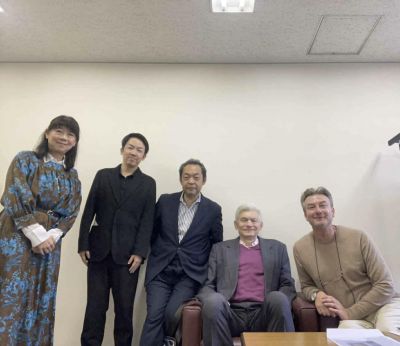
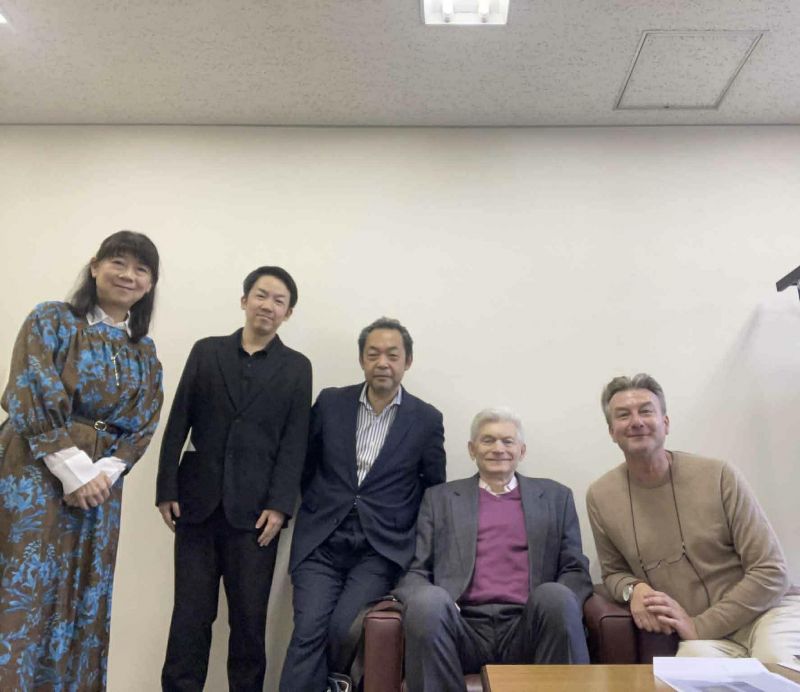
from left to right: Yukiko Sawa, Hiroaki Goto, Kenji Igata, Pavel Foltýn, Christian Arming
Christian Arming and Martinů in Hiroshima
(printed in shorter version in Martinů Revue 1/2026)
On Friday 24th October 2025, the Hiroshima Symphony Orchestra performed Martinů’s Fifth Symphony as part of a subscription concert that also featured Dvořák’s Cello Concerto and the première of a new work by Japanese composer Toshio Hosokawa. The concert was conducted by Christian Arming (A), who was kind enough to give an interview to Yukiko Sawa (S), president of the Japanese IMC, after the concert. Also taking part in the discussion were Pavel Foltýn (F), former flautist with the orchestra, Kenji Igata (I), the orchestra’s general manager and Hiroaki Goto(G), violinist with the Brno Philharmonic.
G: First of all, it's wonderful that the Hiroshima Symphony Orchestra has completed this project.
S: That's right — with this performance, your orchestra has now performed all six of Martinů's symphonies.
A: Yes. The orchestra’s previous conductor, Tatsuya Shimono, began the cycle by conducting the first four symphonies. Last year, I conducted the Sixth and now this year the Fifth.
S: Congratulations. It is especially commendable that a Japanese orchestra has performed all of Martinů's symphonies.
G; What do you think about the orchestra in Hiroshima and the audience for Martinů’s music?
A; I thought yesterday the audience was quite enthusiastic, because I’m sure that they were hearing the work live for the first time. Last year, we played the Sixth Symphony and they were very enthusiastic. The Fifth and Sixth Symphonies are very different, I think the Sixth is much more emotional, and that the Fifth is a more technical score - very rhythmic and the motifs very well integrated. It’s not easy to play, and also I think, it’s not an easy listen for the audience.
F: Why did you choose to perform the Fifth symphony?
A. Because Mr. Shimono had already played the first four symphonies. This was the first time I had done the Fifth. I have played the Sixth Symphony so many times that I could do it without rehearsal even with an unfamiliar orchestra, but the Fifth was new to me.
F. I have played the Fourth and Sixth Symphonies before. They are famous, but the Fifth isn’t so well-known.
A. Yes, the Fourth is famous. With the Fifth, you really have to sort out the rhythm. If I introduce the Sixth to the orchestra first, I can get the orchestra used to the style and go on to tackle the Fifth afterwards.
G: I felt yesterday that the orchestra was really getting used to playing Martinů. It was so amazing.
A: When Mr. Shimono started the cycle, they performed the first four symphonies in the space of a year - a very short time.
F: It was truly wonderful that you performed all of Martinů's symphonies in Hiroshima. This was a very rare event. No other orchestras perform all the symphonies, do they?
S: I wonder if there’s a connection between this country – Hiroshima specifically - and Martinů's music.
I: When we did the first four symphonies, Mr. Shimono was conscious that they were wartime works. But around the Third and Fourth, things start to change, don’t they?
G: That's right, I think so. And how do you feel about the modern-day Hiroshima as a symbol of peace?
A; Yes, it’s very important!
G: And do you feel this is relevant to Martinů’s music?
A: Yes, I was thinking about this the other day. It is a good combination because of the tragic history of this city. The philosophy of the Hiroshima Symphony Orchestra is to speak out and to remind people - not just in Hiroshima but in the whole world – that peace is so important. At the moment, wars are raging in many different parts of the world and it is essential to plea for peace and the cessation of war, to create harmony through our music. This message fits very well with Martinů’s music.
F: There is a movie in Czech called 'Machine Gun to Clarinet' which we were not allowed to watch when the Communists were in power. It was a war movie, although a comedy.
G: Martinu’s music is so full of innocence. I’m from Hiroshima. Since childhood, I have often gone to the Hiroshima Peace Memorial Museum, and to the Atomic Bomb Dome, which was so sad. But, like the film, Martinů’s music can often be humorous.
A: Yes, even in the Fifth Symphony there are many moments like that.
G: Martinů had experienced two world wars, but I don’t see the effect of war on his music, which retains that sense of innocence.
A: Yes, we don’t sense the war directly in his music, do we?
G: So for the people of Hiroshima, it was very nice to listen to.
A: The Fifth Symphony was composed a year after the end of the Second World War, so you would imagine, that there must be some really dramatic and anguished music in it, but it’s not like that at all.
G:; It’s not Shostakovich. It tries to avoid sensationalism.
A: Yes that’s true.
G: My grandfather often spoke about the Second World War, but he only told us good things about it. We always smiled at his stories – Martinů’s music is rather like that.
A: Martinů’s music is not that often performed. Above all, what should be appreciated is that the music itself is interesting, right? It's fascinating. It could also be said that it recalls Janáček's language – the music of both composers is so distinctive. For instance, if you are familiar with some of Janáček’s music but are hearing Taras Bulba for the first time, you know instantly that it must be by him because the musical language is so personal. Martinů is another composer who is instantly recognisable. It’s a shame that these works are not played more often. Of course they are well-known in the Czech Republic, but they are rarities in Japan. I’m talking now not just about the symphonies, but the concertos and other wonderful works like The Epic of Gilgamesh.
G: Have you ever performed The Greek Passion?
A: No, I haven’t, but I would like to perform it and Gilgamesh too, but so far I have performed only the Third, Fifth and Sixth Symphonies, and the First Cello Concerto. I’d really love to do the Fourth Symphony, but at the moment the Sixth is my favourite. When I conduct it, I see images of Prague, Brno, the Czech Republic and its countryside. I have always wanted to ask someone who knows; why did Martinů write the Fifth Symphony? What is this work about?
G: I think it pays tribute to very many things – to Czech music, to Dvořák especially, and of course it expresses his longing to return to Czechoslovakia, which he was never able to do. So memories of Dvořák’s music and of home are intimately bound up with this music – that’s why it was so nice that tonight’s program also featured Dvořák’s Cello Concerto, with Steven Isserlis as soloist. Martinů was asked a couple of times during his life to explain what the Sixth Symphony was about. His answer was always ”I can’t tell you, it’s a very personal thing. The reasons why I composed the Sixth Symphony are not a matter for the public, they are very private to me”. That mystery surrounding the Sixth makes me feel that there may also be some private impulses at work behind the creation of the Fifth Symphony – some concrete reasons why he composed it. Maybe the reasons are the same – nostalgia for home, a longing to return to his roots. It may also be, in the Sixth, that the difficulties he was having in his private life, with his wife Charlotte, had a bearing on the genesis of the work, among other things that were going on at the time.
G: There was an excellent solo [in the Fifth Symphony] from the concertmaster and fine contributions from all the strings. The harmonic language of this piece is often rather obscure.
A: Yes it is, and I have a feeling that there are many misprints even in the score.(Everyone laughs)
A: It’s really complicated, and difficult to verify the harmonies sometimes because I have no access to the manuscripts of Martinů’s symphonies. Maybe you know where they are? They must be in Prague. It would be good to establish what are misprints in the score and what is really wanted by Martinů. Do you know where the manuscript is?
G; In Polička?
F; Maybe elsewhere abroad, or in America?
(After this interview S found out that the manuscript of the Fifth Symphony is currently lost).
S: My nephew likes Martinů very much. He is still a student, but he told me that he wants to ask you that what is the best thing about Martinů.
A: Well the style is very different from that of a composer like Janáček. There are neo-classical elements, which don’t occur so much in Janáček’s music. Janáček’s instrumentation – for instance, in a work like Taras Bulba, is also very unconventional. Martinů’s orchestration is much more traditional but he uses the instruments with consummate skill. He uses the piano in all of his symphonies except the Sixth, and it brings a sparkling colour to the music. His use of the piano is very individual and you could sense that very strongly in tonight’s performance.
S:Yes indeed.
A: And musicians in every country always ask me about syncopations. Sometimes you don’t know where the beat is. In the coda of the Fifth Symphony finale, the tempo is very fast, the melodic entries all come in off the beat, and it’s difficult to play. This is unique to Martinů and it’s an element of his style that I love, but it does make life difficult sometimes!
F: Bar lines don't really matter, do they?
S: The bar lines aren't important; the melody is what matters.
G: Yes, exactly.
G: If you could conduct more Martinů with the Hiroshima Symphony orchestra, what pieces would you like to play?
A: Definitely the Fourth Symphony, which is a very nice piece, and I would love to do the Epic of Gilgamesh, but unfortunately we don’t have a good choir in Hiroshima. The choral parts are very difficult, and the Czech text is difficult too, so we would have to call in a choir from Tokyo, which would be expensive. Gilgamesh is not an easy piece.
G: Someone would have to coach them in the Czech language,
A: Yes, It’s very difficult.
G; But Hiroshima has a very good teacher here in Mr Foltyn.
A: But the Czech language is very difficult. I once performed Janáček’s opera The Markopoulos Case in Tokyo. It’s a very difficult piece, just from the linguistic point of view, as is his Glagolitic Mass.
F; And for the Glagolitic Mass, so you need a really good organist.
S: What do you feel are the main differences between Japanese and Czech orchestras?
A: If you play Martinů with a Czech orchestra, the music is part of their DNA, and it doesn’t matter whether you’re playing Martinů, or Taras Bulba or Má vlast, the Czech orchestra can play it all from memory.
G: Have you played Janáček in Hiroshima?
A; We did Taras Bulba, and of course the Sinfonietta, but only those two I think. We have not played the Glagolitic Mass yet, but it’s a fantastic, colourful piece that I would like to do.
Janáček didn’t write many orchestral pieces, but they can be supplemented by music from the operas. I will soon be doing the overture of From the House of the Dead, and a rather difficult suite from Jenůfa.
G; I hope that the Hiroshima Symphony Orchestra will gain more attention and become internationally recognized. After all, it completed a cycle of Martinů symphonies, and that’s a rare feat worthy of admiration.
A; Yes, it is indeed something very rare. In the beginning, Martinů symphonies were played sometimes in America, by the Boston Symphony, but now who plays Martinů symphonies in the USA?
G: We in the Brno Philharmonic Orchestra played Martinů in America while on tour in February 2023, in Carnegie Hall with Dennis Russell Davies. He is a friend of Philip Glass, and we played Glass’ “Lodger” Symphony alongside Martinů‘s Thunderbolt P-47 and Janáček’s Taras Bulba.
A; Did that work as a program? I can’t imagine Philip Glass and Martinů can work together.
G; It was nice, like minimalism. The American audience was so enthusiastic. There was a standing ovation at the end, when Dennis Russell Davies asked Philip Glass to come and take a bow! Perhaps the Hiroshima orchestra should try the same combination of Martinů and Philip Glass when they come to America!
A; That’s a very good idea
G: I gather that the members of Hiroshima Symphony orchestra also perform chamber music.
A: Yes, many musicians play Martinů’s chamber music, because Martinů’s chamber music is beautiful.
G” In Japan, there are many admirers of Dvořák and Beethoven, and of the Moldau(Vltava) by Smetana, (which is a set work in our schools); the slow movement of Dvořák’s New World symphony is also very well known.
A: But even in Japan, you usually hear only Vltava.
F: But sometimes they play other movements from Má vlast, like Vyšehrad or Šárka.
A: Yes sometimes. For me, personally, Šárka is the best part of Má vlast, almost like a symphony. It amazes me how Smetana managed to set this story to music. We all know that Vltava is beautiful, but Šárka is so dramatic - it’s fantastic.
S : In Japan there was a musicologist specialising in Czech music, Dr. Hideo Sekine, who left behind many materials about Czech music and so many things about Martinů. He passed away in 2017 at the age of 88. In 1990, he founded the Japanese Martinů Society in Tokyo and after he passed away, we continued his work and formed the Japanese branch of the International Martinů Circle in Japan.
F: Dr Sekine was an Ear Nose and Throat doctor by trade. It is great that the IMC in Japan is continuing his good work.
G: He wrote a great deal about Martinů.
A : There’s still so much research that could be done about Martinů, mostly in English or German, or of course in the Czech language.
S: Yes, we’d like to do some more in Japanese, some day.
Text was prepared by Yukiko Sawa and Michael Crump.
24 October 2025
The Hiroshima Symphony Orchestra
Conductor Christian Arming
Programme:
- Bohuslav Martinů: Symphony No. 5
- Toshio Hosokawa: new orchestral work (premiere)
- Antonín Dvořák: Cello Concerto in B minor, Op. 104 – Steven Isserlis, cello
You can listen the concert here:
https://1url.cz/beBAu